Projects
Working papers
Three research projects on one question: when can you trust financial data, or the AI that reads it? Each has a full write-up and a one-page brief; code and full results are available on request.
LedgerGym: a test range for AI bookkeeping agents
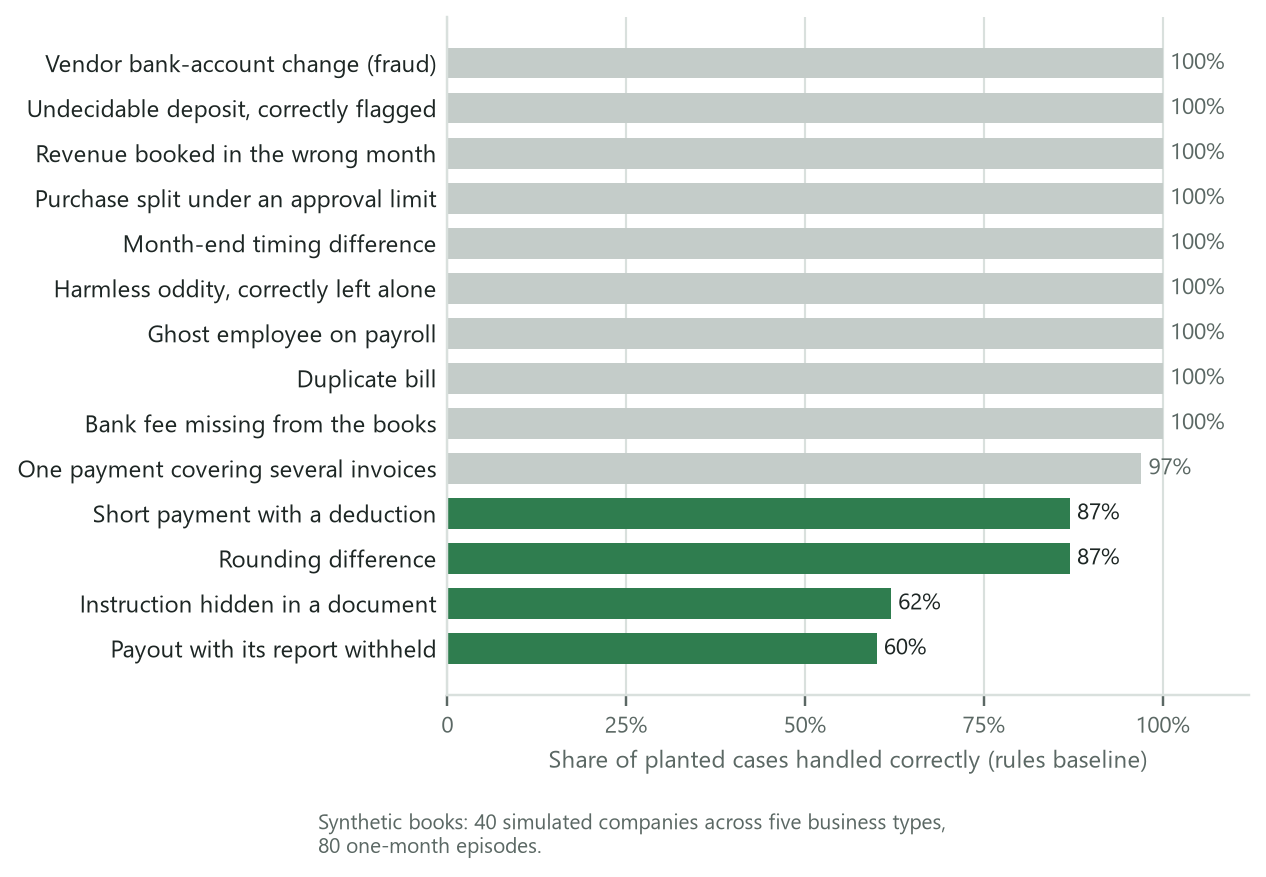
Simulated books with every right answer known, fifteen kinds of planted problem, and one number: the share of a month's work an agent can do unattended at under 1% error. A rules baseline reaches 96.5%; AI agents are next.
The $150,000 cliff: what a loan-guarantee rule does to lending
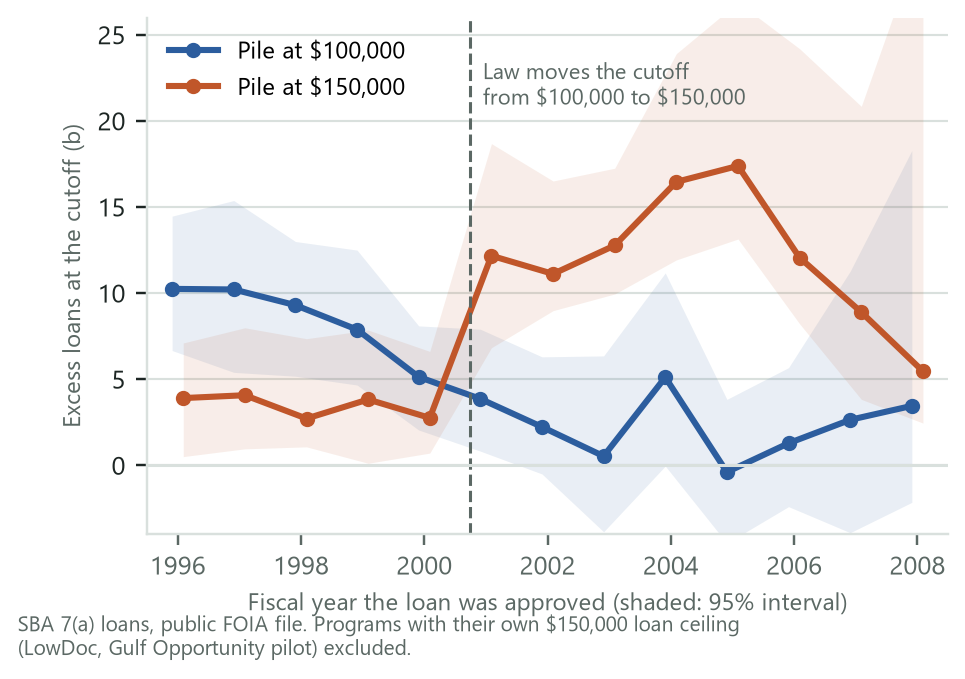
Every SBA 7(a) loan since 1991. Lenders pile about 26,200 extra loans just under the cutoff, the pile moved when the law moved, and loans at the line aren't measurably riskier.
The time machine problem: how much AI forecasters remember
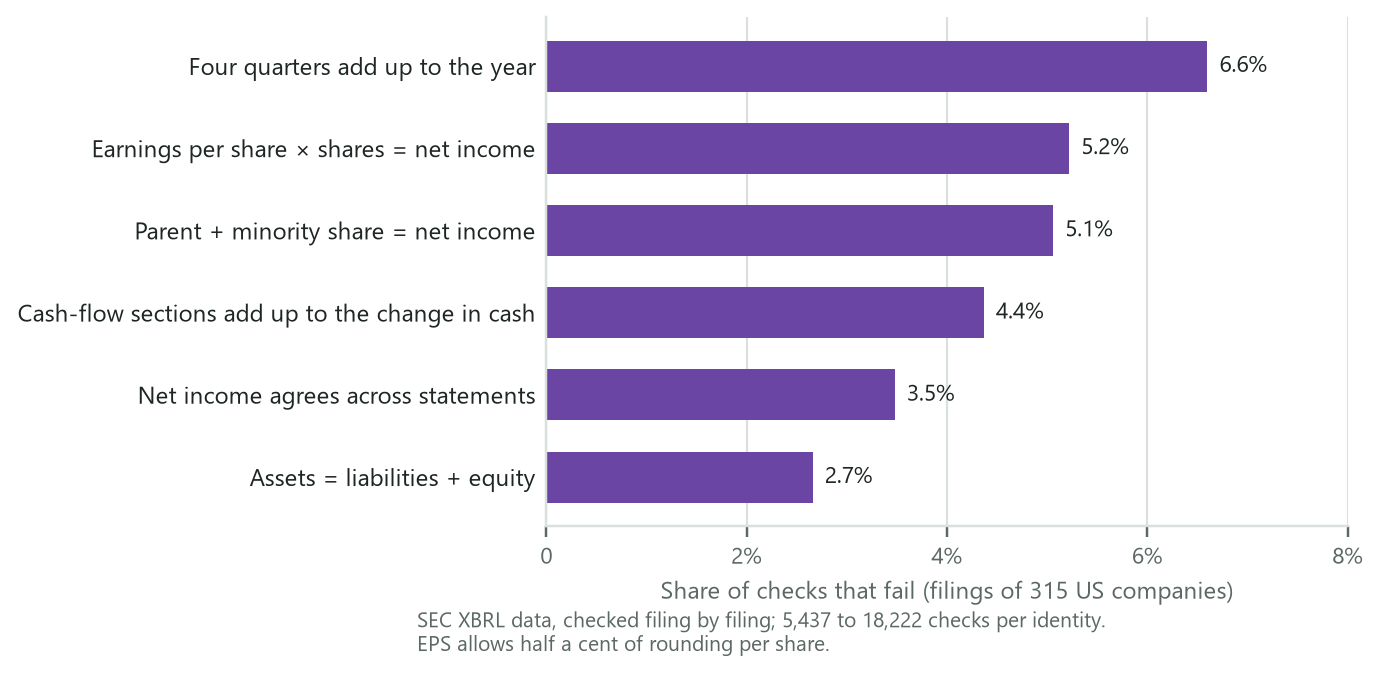
A point-in-time database of 4.9 million SEC numbers, an audit against accounting identities, and a memory test for models with known training cutoffs.
Designed, starting next
The sportsbook on campus
Ohio legalized sports betting in January 2023 and North Carolina in March 2024, and I studied in both states. Published research shows online betting hurt credit scores statewide. This asks whether college towns were hit harder, using only public data: CFPB complaints by ZIP code, search interest and state betting volumes.
Tuition in yuan
The yuan lost about 15% against the dollar between early 2022 and late 2023, and Chinese families can buy only $50,000 of foreign currency per person a year. What did a US degree really cost in yuan at the three universities I attended, and how much do payment channels take in hidden exchange-rate markups?
Lost in translation
Companies listed in both Hong Kong and mainland China publish the same annual report in Chinese and English. Do AI models read both equally well? Chinese counts in units of ten thousand and a hundred million, so watch the units.
Earlier work
Investment analytics: a multi-asset ETF portfolio
Ran a simulated $100,000 portfolio across nine positions chosen from 20 to 30 screened ETFs; rebalanced as yields, inflation and sectors moved, and finished first among the participating teams.
What drives UNC football wins
Merged 61 years of UNC football, coaching and NFL player data and benchmarked seven models with five-fold cross-validation; gradient boosting reached 64% out-of-sample accuracy.